
Article
What sticks, sticks.
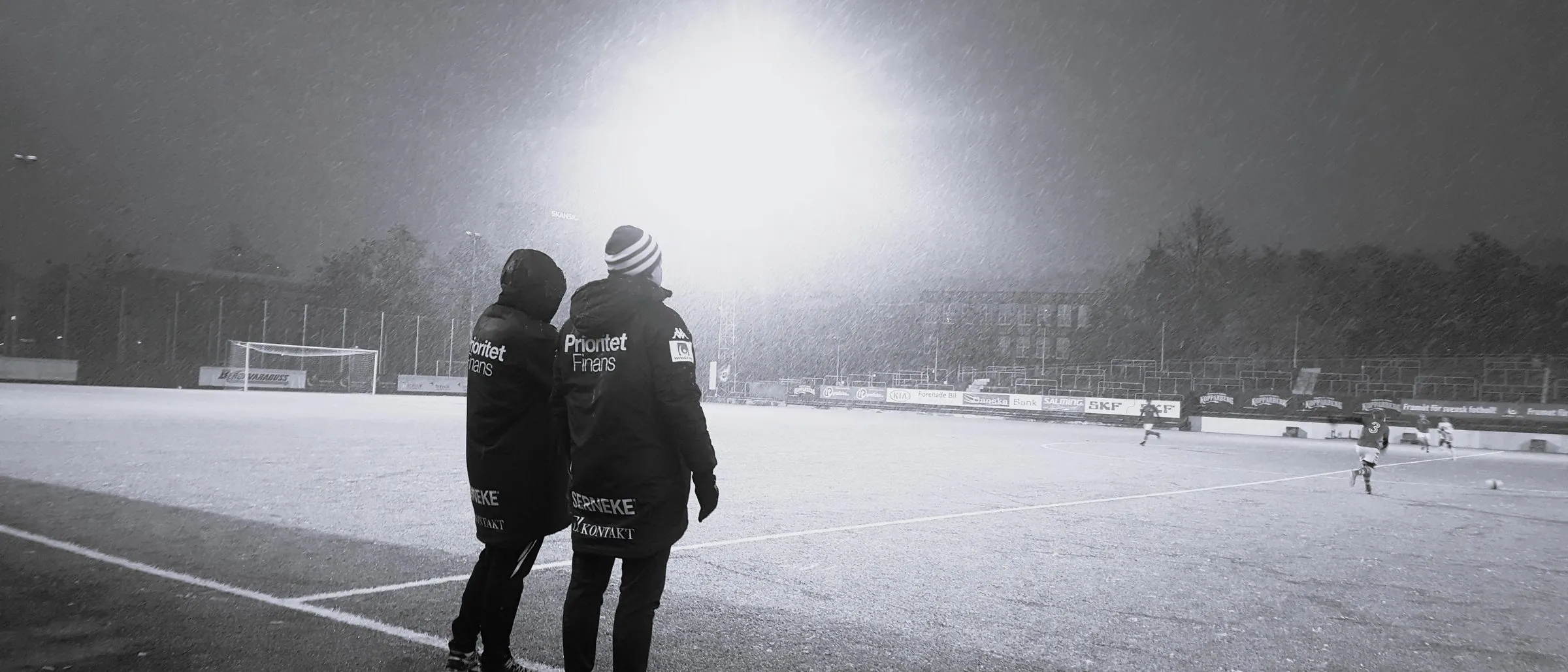
I've been on a great many courses over the years, in sales, in leadership, in coaching and in things like sports injuries. Add all the conference talks and all the workshops, and it adds up to an awful lot of hours spent listening to theses, models, methods and philosophies. Even so, only a fraction of it stuck. This piece is about why, and about the insight that only arrived as I was approaching forty: what sticks, sticks, and the rest I get to carry on practising.
All those hours
Compulsory school, upper secondary, IHM, a Swedish business school. Various sales courses and various leadership courses. Levels one and two in general sport, in judo and in football. The coaching course Fotbollens hemligheter, the secrets of football. Sports injuries one and two. Conference talks, coaching meet-ups, workshops.
It makes an impressive list on paper, and that’s roughly what it’s worth. Because I can honestly say I don’t use even a tenth of what I sat and listened to. Not because the content was poor, but because for a long time I misunderstood what actually happens when you learn something.
Trying to become someone else
Early in my career I looked at other people and tried to become them.
The clearest example is Roger Gustavsson at IFK Göteborg, a top Swedish football club. He’s a coach I really look up to and a wonderful teacher. I watched and I listened, and I tried to become him. I did the same thing with salespeople I admired and with the leaders around me.
I was often disappointed in myself, for two reasons that I could only tell apart much later.
One was that I never came across as genuine. When I tried to use strengths I thought someone else had, mostly what I did was repeat what that person had said, and my own strengths never came out, because I was putting all my energy into being someone else and lost track of them along the way.
The other was that I missed a whole lot of things, because they weren’t in my bones. I knew perfectly well that I ought to think or act in a certain way, and then I didn’t do it anyway. The ability was there but only as a thought, and the disappointment was all the greater because I could point to exactly what I should have done.
The four stages of competence
It was only much later that I found the words for it, and they sit in an old model of how learning actually works.
Unconscious incompetence. You don’t know what you don’t know.
Conscious incompetence. You discover what you’re lacking.
Conscious competence. You can carry out the task, but you have to stop and think.
Unconscious competence. The knowledge is in your bones and happens automatically.
With that in hand, my disappointment makes sense. I was in conscious competence and believed I was in unconscious. Everything I’d learned required me to remember, in the middle of a conversation or in the middle of a training session, to use it, and when it really mattered I did what I’d always done. That isn’t a character flaw, it’s simply what conscious competence means.
The model is usually attributed to Noel Burch at Gordon Training International in the seventies, and that’s the most common and most reasonable connection. It does, however, appear in a textbook on training programmes as early as 1960, written by three teachers at New York University, and it’s often wrongly attributed to Abraham Maslow, even though it doesn’t appear in any of his major works.
The insight came late
I was probably getting close to forty when it fell into place, and the insight was simpler than you might expect.
What sticks, sticks, and that’s what I’ll use. What hasn’t stuck, I carry on reading up on, practising and bringing out now and then until it does. I couldn’t become Roger Gustavsson, but I could become a better Johan, inspired by him and by a whole range of other coaches.
Over the years it got easier and easier, for a reason that sounds obvious and isn’t: just because I’ve read or heard something doesn’t mean it’s usable right now. It has to be repeated and practised, and eventually it sticks and you’ve got a little bit better.
The same thing at work
It turned out to be exactly the same in the day job. I used the same method there and felt a completely different kind of calm.
I developed at my own pace, accepted where in the process I actually was, and made my judgements from there instead of from where I thought I ought to be.
Always? No, of course not. Plenty of times since then I’ve been frustrated and disappointed too. The difference is that these days I understand why it happens and what to do about it, and honestly that’s the whole gain.
It connects to the master painter’s saying that cheating is a master’s privilege. The shortcut is only available once the work has been done the long way enough times, which is to say only in unconscious competence. Take it in conscious competence and you’re not making a shortcut, you’re making a leap.
And the curve that doesn’t really exist
There’s a related observation worth bringing along, namely that the more you learn about something, the less of an expert you think you are. It’s usually called the Dunning-Kruger effect, and it cuts both ways. Sometimes it’s genuinely rather nice to be unconsciously incompetent and think you know everything.
The original, though, is less picturesque than the popular version. The curve that usually gets shown, with a confident peak early on and a deep valley after it, does not appear in the 1999 study. What Dunning and Kruger found was that those who performed worst greatly overestimated their own ability, which is to say that judgement about oneself is poorest in the person who knows least.
The point holds anyway, and it’s a comforting one. The feeling of knowing less and less is often a sign that you’ve learned more.
Something to try
Take three things you’ve been on a course in and place each one at one of the four stages, honestly.
What you find in conscious competence is what requires you to remember, and it’s also what disappears first when you’re under pressure. Either you decide to practise it until it sticks, or you decide to let it go. Both are reasonable decisions. What isn’t reasonable is to carry on being disappointed in yourself over something that never got the repetition it needs.
Then do the same thing with someone you lead. The conversation at the next development review turns into a different one if the two of you can say together what has stuck and what still takes conscious thought.
In practice
What moves something from conscious to unconscious competence is the same thing being brought out several times, in situations that matter, by someone who remembers that it came up last time. A course does it once and moves on, and that’s why a course so rarely does the job for someone who’s already been on plenty. A recurring conversation does it until it sticks, and it matters less whether that’s a mentor, an old colleague or someone else with the patience to ask a third time.
And that applies to me as much as to the person I’m talking with. I’m still not finished, there are still things on my list that sit there only as a thought, and I’ve stopped being disappointed about it.